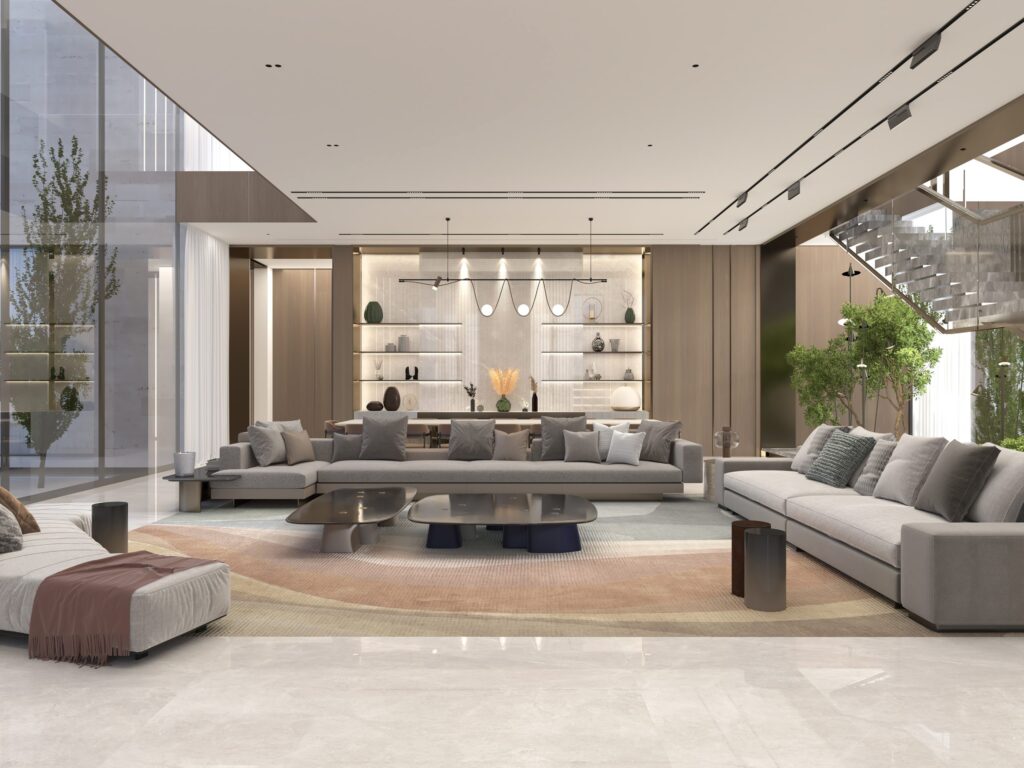
The materials used in luxury interior design in Dubai are, above all, natural stone (marble, travertine, onyx), solid timber (walnut and oak), and a small number of carefully chosen metals, textiles and plasters. What makes them luxurious is not the name on the sample but how they are chosen, matched and detailed: slabs selected to work together, stone carried across floors and walls without a break, timber that warms a room of stone, and finishes that stand up to the Gulf’s sun, heat and air-conditioning.
IDEA ART Interior Architects (IAIA) has designed interiors from Dubai since 1994, on more than 320 projects in 12 countries. Below is how we think about materials, with the houses where each decision was made.
Why materials matter more in a luxury interior in Dubai
In a large villa, materials do the work that furniture cannot. They carry a room’s atmosphere at the scale of the architecture: a double-height reception, a long gallery, a staircase seen from three floors. A sofa can be changed in a week; a stone floor stays for decades. That is why we decide the material palette early, at concept stage, alongside the plan and the light, rather than at the end as a decoration exercise.
Dubai adds its own conditions. Strong daylight fades fabrics and timber left in direct sun, rooms swing between hot terraces and cooled interiors, and sand finds its way into every joint. A good palette is chosen with this in mind: durable surfaces where people walk, softer materials where light is controlled, and details that are easy to maintain.
Marble: one material, many moods (Villa K)
Villa K, a 770 m² private residence in Millennium Estates, Meydan, completed in 2023, began with a single question: what can be done with marble? “We wanted to show what can be done with marble,” says IAIA Head of Design Darine Jabeili, who led the project.
The answer is a house where depth, tone and atmosphere come almost entirely from stone. Slabs were chosen to match one another, then wrapped across floors and walls, laid in chevrons at the entrance and fluted in the reception. Upstairs, each bedroom and bathroom takes its own marble and its own mood: grey, black-and-gold or honey onyx, all set against walnut and calm daylight. The dining hall gathers around a table of green-veined stone.
The lesson from Villa K is that marble works best as a system, not a feature. Matching slabs, deciding where veins meet and how a pattern turns a corner is drawing work done before a single slab is cut. The house won Best Luxury Villa Interior Design in Dubai, UAE at the Luxury Lifestyle Awards 2024 and Residential House Under £1M at the SBID International Design Awards 2023, and was an ArchDaily 2024 Building of the Year finalist.

Travertine: a calm base for a whole house (The Canvas)
Travertine is quieter than marble: warm, porous-looking, matte. It suits houses that want to feel grounded rather than polished. At The Canvas, a 1,200 m² private residence in Sharjah completed in 2024, the studio’s line was “Space is the canvas, art is the architecture.” The house is a long, low travertine volume on an elevated platform, pierced by water and planted patios.
The materials change as you move through it. Grey basalt and beige travertine define the shared rooms near the entrance; oak takes over in the private rooms at the far end; a darker veined stone gives the dining hall its weight; the master bathroom is in walnut and stone. Changing the material is how the house tells you that you have moved from public to private, without a single door.

Stone inside and out: one palette from facade to room (Echoes of Stone)
When the same studio designs the architecture and the interior, the materials can travel from outside in. Echoes of Stone, a 2,400 m² residence in Dubai now under construction, wraps an existing villa in travertine over a base of hand-laid brick, with perforated screens across the upper floor to filter the sun.
Inside, travertine lines the walls and floors and walnut screens filter light along a double-height gallery, where the stair rises beside an indoor tree. Against this calm base of stone and timber, rust and red appear in measured doses: dining chairs, a cluster of red glass in the library, a red onyx bath. The master suite pairs green marble with soft upholstery. The project received an Honorable Mention in Architecture – Housing at the DNA Paris Design Awards 2026.

Timber, plaster and textiles: the materials that make stone livable (Silent House)
A house of stone alone can feel cold. Timber, plaster and textiles are what make it a home. At Silent House, a 1,200 m² private residence in Dubai under construction, led by Darine Jabeili, the studio’s line is “The Silent House speaks” — through colour, form, texture and light. Warm oak joinery, soft plaster, terracotta tones and patterned wool rugs set the base. Stone is used where it can be felt most: two powder rooms, each carved from a single stone, one rose marble and one deep green.
Walnut and oak are the two timbers we return to most. Walnut is darker and suits slatted walls, screens and joinery in rooms with controlled light; oak is lighter and calmer, good for panelling, wardrobes and libraries. Both are specified with finishes and edge details that cope with air-conditioned interiors.
Metals and glass: used sparingly
Brass, bronze and blackened steel still have a place in luxury interiors, but in our work they are accents: a pendant, a handrail, a shadow-gap trim, a joinery handle. Glass does a similar job with light. In Villa K’s reception, a cloud of glass pendants hangs above a fireplace wall of travertine and walnut shelving; at Echoes of Stone, red glass lights the library. A few precise moments of metal or glass read more clearly against stone and timber than a room full of them.
How we choose and detail materials, step by step
On every project, the material palette follows the same sequence:
- Concept first. The palette comes from the idea of the house (marble as a question at Villa K, travertine as a natural formation at The Canvas), not from a trend list.
- Light and use. We check each surface against where the sun falls, how the room is used and how much wear it takes.
- Samples and slabs. Stone is selected slab by slab where possible, and joints, vein direction and edge profiles are drawn.
- Detail drawings. Joinery, stone layouts and transitions between materials are resolved in technical drawings before anything is ordered.
- Site checks. Mock-ups and installed work are reviewed on site through our project supervision.
Furniture, lighting and textiles follow the same palette; when the design team also handles furniture and design procurement, finishes stay consistent from drawing to delivery. The whole process is part of our interior design service in Dubai and the UAE. For how materials work with climate and orientation in a new villa, see designing a villa for Dubai’s light and heat and villa interior design in Dubai.
Luxury interior design materials in Dubai: FAQ
Which stone is best for a luxury villa in Dubai?
It depends on the room and the mood. Marble suits rooms meant to feel rich and reflective; travertine suits calm, grounded spaces and works inside and out; onyx is best kept to a few moments, often backlit or in a bathroom.
Is natural stone practical in Dubai’s climate?
Yes, when it is specified and finished for its use: honed or textured finishes where people walk, sealed surfaces in kitchens and bathrooms, and joints designed to keep sand and dust out.
Can marble and timber be used together?
They are one of the most reliable pairings. At Villa K and Echoes of Stone, walnut warms rooms that are otherwise built of stone.
Are engineered or synthetic materials ever the right choice?
Sometimes — for example on surfaces that take heavy wear or where a large, seamless piece is needed. We choose them on performance, and say plainly what they are.
When should materials be chosen in a project?
At concept stage, with the plan and the light. Late material changes usually mean redrawing details and reordering.
If you are planning a villa or residence and would like to see material samples from current projects, our studio is in Dubai Design District, Building 5, A204 — contact us to arrange a conversation.