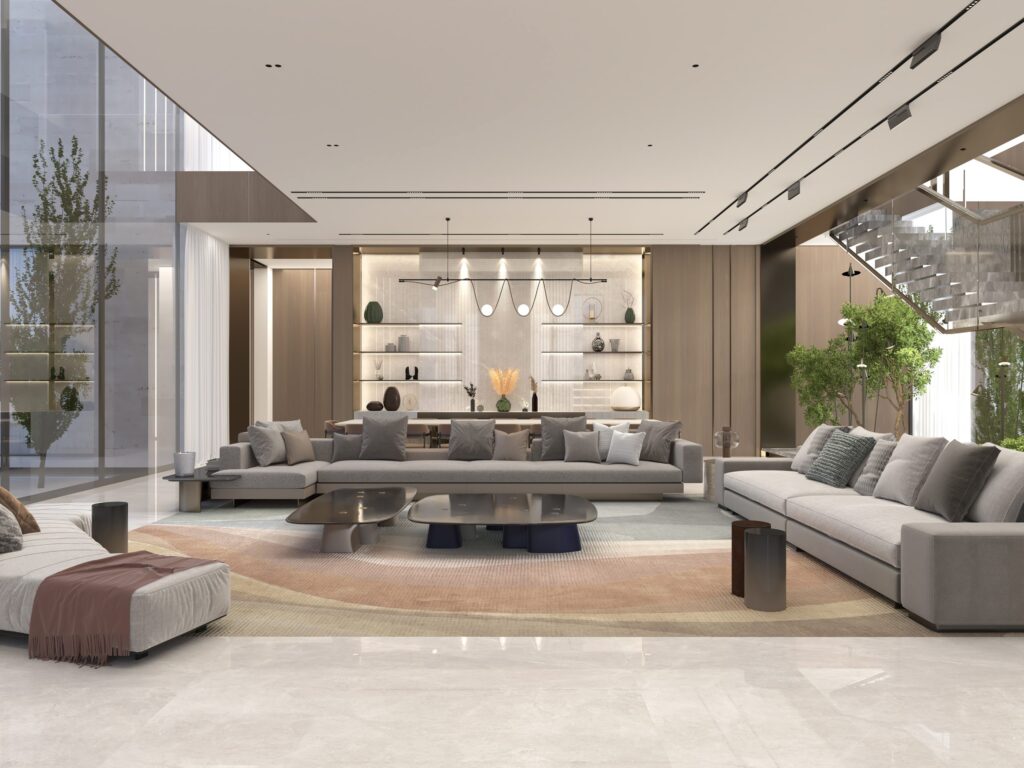
A private office in Dubai works when it is designed as part of the whole floor, not furnished as a room on its own: its place in the plan decides how private it is, its materials say who sits there, and its light, acoustics and furniture decide whether the person can actually work in it all day. The rooms around it — a majlis for guests, a board room, a meeting space that can open or close — matter as much as the desk. This guide sets out how we approach private and executive office interior design, using the Amanat Office at Dubai World Trade Centre, a 750 m² floor IAIA completed in 2022, as the worked example.
It is written for owners, CEOs and family offices planning a new office floor or refitting an existing one, who want a workplace that receives visitors well and still serves the people who use it every day.
What private office interior design involves
A private office is the room where a company’s leadership works, meets and receives. In the Gulf it usually has to do several things at once: a quiet place to read and decide, a room to host guests with proper hospitality, and a link to the team without being on show. The design starts with the brief — who uses the room, who visits, how confidential the work is, how often meetings happen there rather than in a meeting room — and only then moves to finishes and furniture.
For the Amanat Office, an investment company’s floor, the brief asked for three qualities: excellence, elegance and boldness. Everything that followed came from turning those words into a plan.
Start with the plan: where the private office sits
Privacy is mostly decided by the plan. An executive office placed at the end of a sequence — reception, then a lobby, then a corridor — is protected by distance rather than by locked doors, and guests arrive at it gradually.
At the Amanat Office, a single longitudinal line splits the floor into two sections: executive and operations. The floor, the ceiling and the timber cladding change across that line, so the two sides answer each other and everyone can read where they are. The executive side holds the CEO and CFO offices, the board room and the majlis; the operations side holds offices shaped around each role and a co-working area for the associates. The private offices gain their calm from the plan, not from closing themselves off.
Materials that set the tone of an executive office
An executive office is read in the first seconds, and the materials do most of that work. Natural stone and dark timber give weight and permanence; lighter woods and brighter surfaces make working rooms feel open. Choosing a small number of materials and using them consistently says more than many finishes.
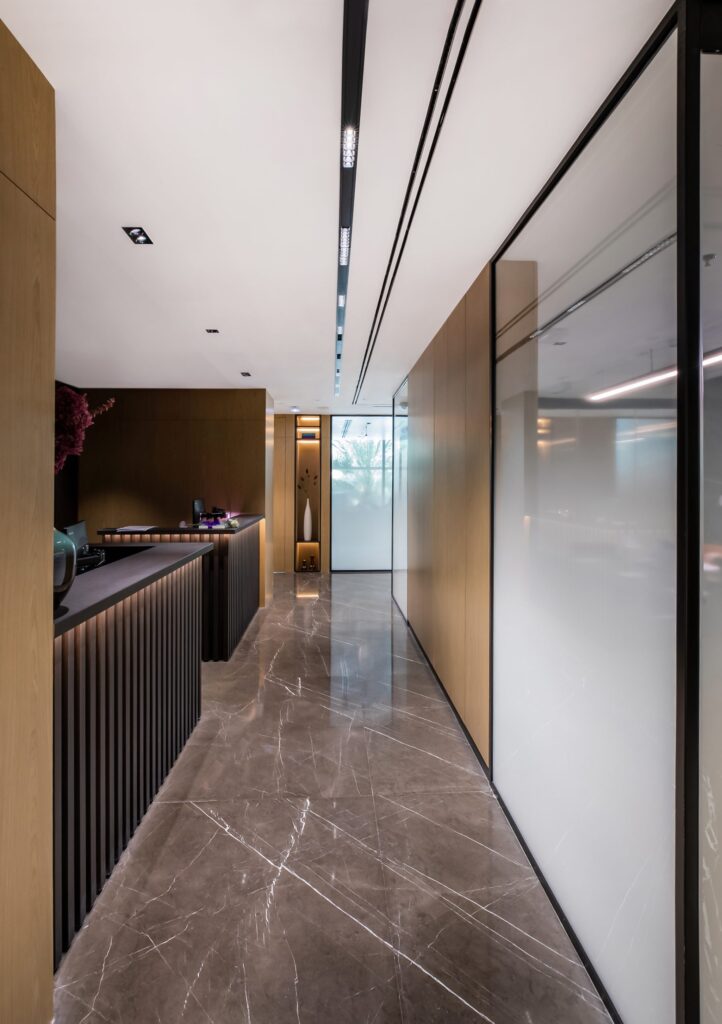
On the executive side of the Amanat Office, the lobby combines white marble floors with dark timber slats, and the reception desk is carved from a monolithic block of grey marble, with a bench of thin Calacatta and Pietra Grey slabs. The executive offices and majlis continue in walnut, grey marble and deep sofas. The operations side changes to light oak cladding and doors. Two palettes, one floor: the change in material is the change in use.
We explain how we select and detail stone and timber in materials in luxury interior design in Dubai.

The majlis and board room: receiving guests
In the UAE, a senior office often receives guests the way a home does. A majlis next to the private office — low, comfortable seating arranged for conversation, with space for coffee to be served — lets a meeting begin informally and keeps the desk for work. The board room, by contrast, is built for decisions: a long table, good acoustics, screens that disappear when not needed.
At the Amanat Office, the CEO and CFO offices, the board room and the majlis follow one another on the executive side, so guests move from reception into the right room without crossing the working floor.
Meeting space that adapts
Meeting rooms are often either too closed or too exposed. A room that can change gives the team both. On the operations side of the Amanat Office, the meeting room is built as a convertible box in the middle of the floor: fully closed for a confidential discussion, or fully open onto the floor when the team works together. One built element replaces two rooms.
Light, acoustics and comfort for long days
A private office is used for many hours a day, so comfort is a design matter, not an accessory. Daylight should reach the desk without glare on screens; in Dubai that means blinds or screens planned with the glazing. Artificial light is best layered — general light, a focused light at the desk and soft light on walls and shelving — so the room works at seven in the morning and late in the evening. See the use of lighting in luxury interior design.
Acoustics decide whether a conversation stays private: solid partitions, acoustic ceilings, timber slats and soft furnishings all absorb sound. The chair and the desk height should fit the person who uses them every day, and storage should be built in so the room stays clear.
Private office design trends that are worth following
Some office trends pass quickly; a few hold because they answer how people work:
- Fewer, better pieces — a substantial desk, built-in shelving and a seating area, rather than a room full of furniture.
- Natural materials — stone, solid timber and leather that age well and need little upkeep.
- A place to step away from the desk — a sofa or majlis corner within or next to the office.
- Planting and daylight — greenery and views where the plan allows, with shade planned for the Dubai sun.
- Technology out of sight — screens, cabling and controls integrated in the joinery from the start.
From brief to a finished office floor
IAIA has designed interiors from Dubai since 1994 — more than 320 projects in 12 countries, 69 of them F&B, corporate and commercial. The Amanat Office won Best Office Design, Dubai and the Grand Prize (5 stars) for Best Office Design, Middle East at the Arabian Property Awards 2022, and was a finalist at the SBID International Design Awards 2022 (Office Design Under 2,000 sqm); see all our awards.
Our interior design service in Dubai and the UAE covers the office from concept to handover, our project management and design guardianship keeps the fit-out true to the design, and our furniture and design procurement team sources the pieces.
Private office interior design in Dubai: FAQ
How private should an executive office be?
As private as the work requires. Most privacy comes from the plan — placing the office at the end of a sequence of spaces — with solid partitions and acoustic finishes where conversations must stay confidential. Glass can still be used where the team should feel connected.
Should a private office in Dubai include a majlis?
If the office receives guests regularly, yes. A majlis or seating area next to the office lets meetings start informally and keeps the desk for work. Where space is short, a seating corner inside the office does the same job.
Which materials work best in an executive office?
A small palette of natural materials — stone, solid or veneered timber, leather and wool — used consistently. They give the room weight and age well. Lighter woods suit working areas; darker timber and stone suit executive rooms.
Can an existing office be refitted without moving out?
Often in phases, depending on the extent of the works and the building’s rules. We agree a programme and phasing with you and the building management at the start.
Do you design home offices as well?
Yes. A study in a villa follows the same principles — place in the plan, daylight, acoustics and built-in storage — scaled to the house and designed with the rest of the interior.
Planning a private office or a new office floor in Dubai or the UAE? Contact the studio to arrange a conversation.