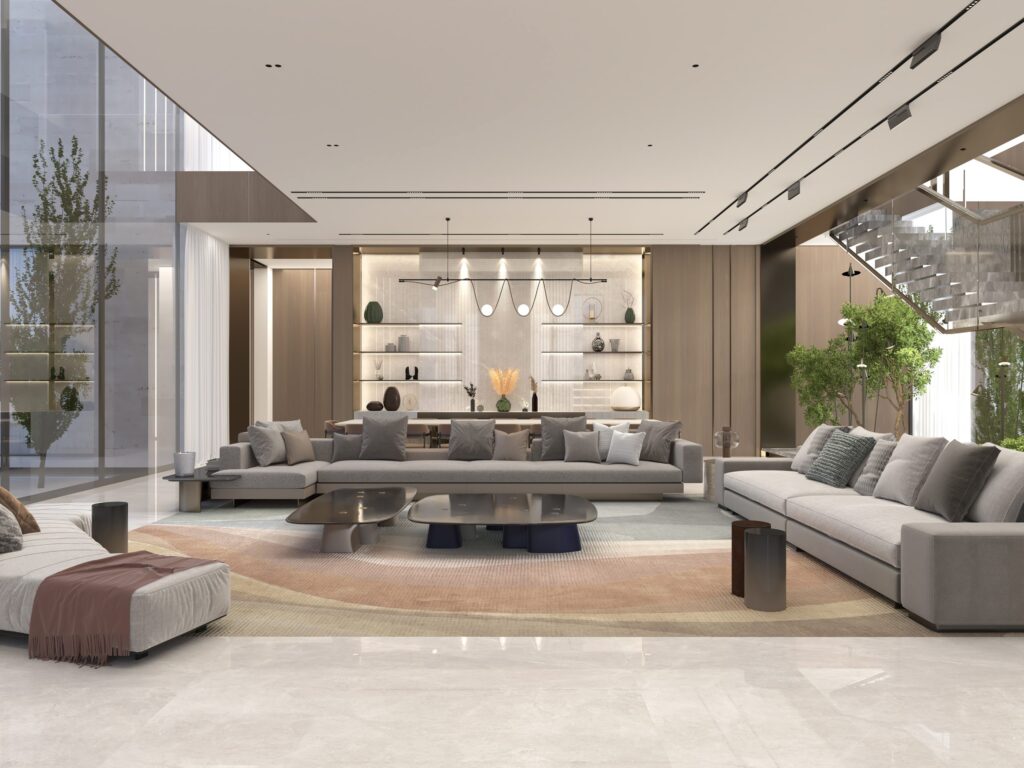
The home interior design trends that matter in Dubai now are less about a look and more about how a house is made: natural stone and warm timber instead of high gloss, rooms organised around planted courtyards and filtered daylight, and colour used in measured doses rather than everywhere. These directions last because they answer the climate and the way families in the UAE actually live. A trend worth following is one you would still choose in ten years.
This guide looks at the directions we see in the houses we are designing today, and explains each one through IAIA projects in Dubai and Abu Dhabi. It is written for homeowners planning a new villa or a full renovation who want to understand what will age well.
How to read home interior design trends in Dubai
Trend reports are written for global audiences. Many of the looks they promote were designed for northern light, small apartments and cool winters. A Dubai house has different conditions: strong sun for most of the year, long summers spent indoors, large family programmes with formal and private areas, and a garden that is only used when it is shaded.
So the useful question is not “what is in fashion?” but “does this direction work in this climate, for this household, for many years?” The trends below pass that test. Each one is shown in a real house, with the decisions behind it.
1. Natural stone and warm timber, honestly used
The clearest shift in luxury home interiors is away from polished, reflective surfaces towards materials that show their nature: honed travertine, marble with real movement, oak and walnut with visible grain. Sometimes called “quiet luxury”, it is really a return to material quality over decoration.
At Echoes of Stone, a 2,400 m² private residence in Dubai, the materials of the architecture come indoors. Travertine lines the walls and floors, and walnut screens filter light along a double-height gallery, where the stair rises beside an indoor tree. The palette is calm on purpose, so that a few stronger moments can stand out.

Stone and timber also suit Dubai practically. Honed stone stays cool underfoot and hides wear better than gloss; solid timber joinery can be refinished rather than replaced. We explain how we choose and detail these materials in materials used in luxury interior design in Dubai.
2. Colour in measured doses
After years of grey and beige, colour is returning to Dubai homes — but as an accent against a quiet base, not as a scheme for every wall. Deep greens, rust, terracotta and rose read well in strong light and warm up stone and timber.
In Echoes of Stone, rust and red appear in measured doses: artwork, dining chairs, a cluster of red glass in the library, a red onyx bath in the master suite, where green marble sets the tone of the bedroom. At Silent House, two powder rooms are each carved from a single stone, one rose marble and one deep green. Colour becomes a material decision, made once and built in, rather than a paint choice that dates.
3. Biophilic design: courtyards, planting and the garden inside
“Biophilic” is a fashionable word for something Gulf architecture has always done: bring planting, shade and air into the centre of the house. In current Dubai villa interiors this means internal courtyards, indoor trees, rooms that open to gardens on more than one side, and roof terraces with planting.
Silent House, a 1,200 m² residence in Dubai led by Darine Jabeili and now under construction, is assembled around a planted courtyard at its centre. Its living and dining rooms open onto gardens and courtyards, and a roof lounge and terrace look out over planting and sky. The studio’s line for the house is “The Silent House speaks” — through colour, form, texture and light.

Planting only works with shade and orientation planned from the start. We cover that side in designing a villa for Dubai’s light and heat.
4. Concepts drawn from place, not from a style catalogue
Clients increasingly want a house that belongs to where it stands rather than a borrowed style — “modern classic”, “Scandinavian”, “industrial”. The strongest interiors start from an idea rooted in the site.
Villa Sira, a 750 m² interior on Jubail Island, Abu Dhabi, takes its concept, Roots & Light, from the island’s mangroves. In the studio’s words, the project “does not imitate mangrove, it is structured by their underlying logic.” Warm sand travertine stands for the island floor, sage and olive green for the canopy — carried as a green marble from the stair to the kitchen island — cream for filtered light, brass for water at sunset and warm wood for the earth.
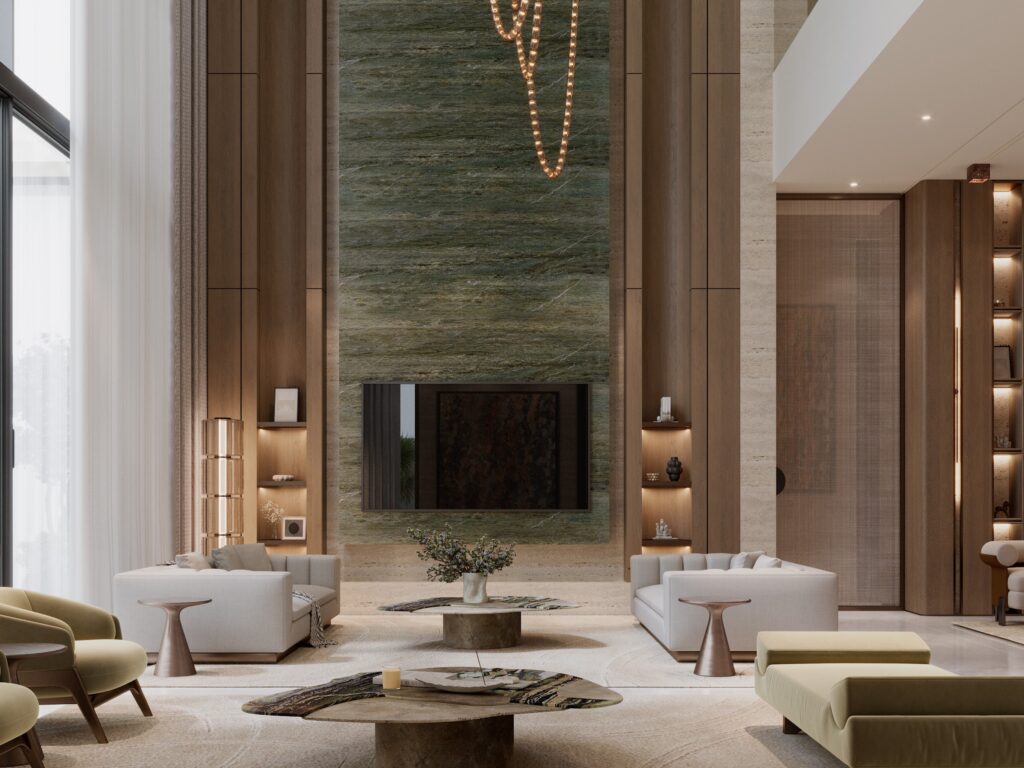
A concept like this gives every later decision a reason, from the curve of a wall to the colour of a fitting. That is why it lasts longer than a style.
5. Light that is filtered, layered and indirect
In Dubai, daylight is abundant and harsh, so the trend is to filter it: skylights, screens, deep openings, double-height volumes where light falls from above. At night, indirect and layered lighting replaces a single bright ceiling.
At Villa Sira, double-height volumes at the entrance and family sitting room let light fall through the house beside a floating stone stair, while private rooms close in, with curved walls and indirect light. Silent House uses skylights over its living rooms; Echoes of Stone filters light through walnut screens. Our article on the use of lighting in luxury interior design goes further into this.
6. Rooms with their own character, in one coherent house
Large Dubai villas used to be finished in one uniform scheme from majlis to bedrooms. The current direction is a house of distinct rooms — a library, a studio, a cinema, a gym, a roof lounge — each with its own mood, held together by a shared palette.
Silent House begins from the idea of a heterotopia, a world within worlds: each room is allowed its own character, and the house is assembled from these entities. Echoes of Stone places a library between two small planted courts, with a cinema and an office nearby. The result is a home that supports how a family spends its days, not only how it receives guests.
Which home interior design trends to avoid in Dubai
Some directions date quickly or struggle in the climate: high-gloss finishes that show every mark in strong light, fabrics and colours that fade near large glazing, “statement” pieces chosen before the plan is fixed, and imported looks that ignore privacy, shade and the separation of formal and family areas. A good test is to ask whether a choice solves a problem in the house. If it only follows a picture, it will probably be replaced.
Turning trends into a house that lasts
IAIA has designed interiors from Dubai since 1994 — more than 320 projects in 12 countries, 210 of them residential. The houses that age best start with a clear concept, a short list of honest materials and a plan built around light, shade and the household’s daily life. Trends then become details within that frame, not the frame itself.
If you are planning a villa, our interior design service in Dubai and the UAE covers the work from concept to handover, and our guide to luxury villa interior design in Dubai explains the process step by step.
Home interior design trends in Dubai: FAQ
What are the main home interior design trends in Dubai now?
Natural stone and warm timber, colour used as an accent, planted courtyards and indoor greenery, concepts drawn from the site, filtered and indirect light, and houses made of distinct rooms with a shared palette.
Is “quiet luxury” suitable for a Dubai villa?
Yes, when it means material quality rather than an absence of character. Honed stone, solid timber and well-made upholstery suit the climate and age well; a few measured accents of colour keep the rooms warm.
How do I keep a new interior from looking dated in a few years?
Start with a concept tied to the site and the way you live, choose a small number of durable natural materials, and build colour into materials such as stone rather than relying on finishes that will be repainted.
Do trends differ between Dubai and Abu Dhabi homes?
The climate and family programmes are similar, so the same principles apply. The difference comes from each site — Villa Sira on Jubail Island, for example, draws its palette from the island’s mangroves.
When should trends be discussed with the interior architect?
At the concept stage, before plans are fixed. That is when light, courtyards, room character and the material palette are decided, and when a direction can shape the house instead of being added later.
Planning a home in Dubai or the UAE? Contact the studio to arrange a conversation.