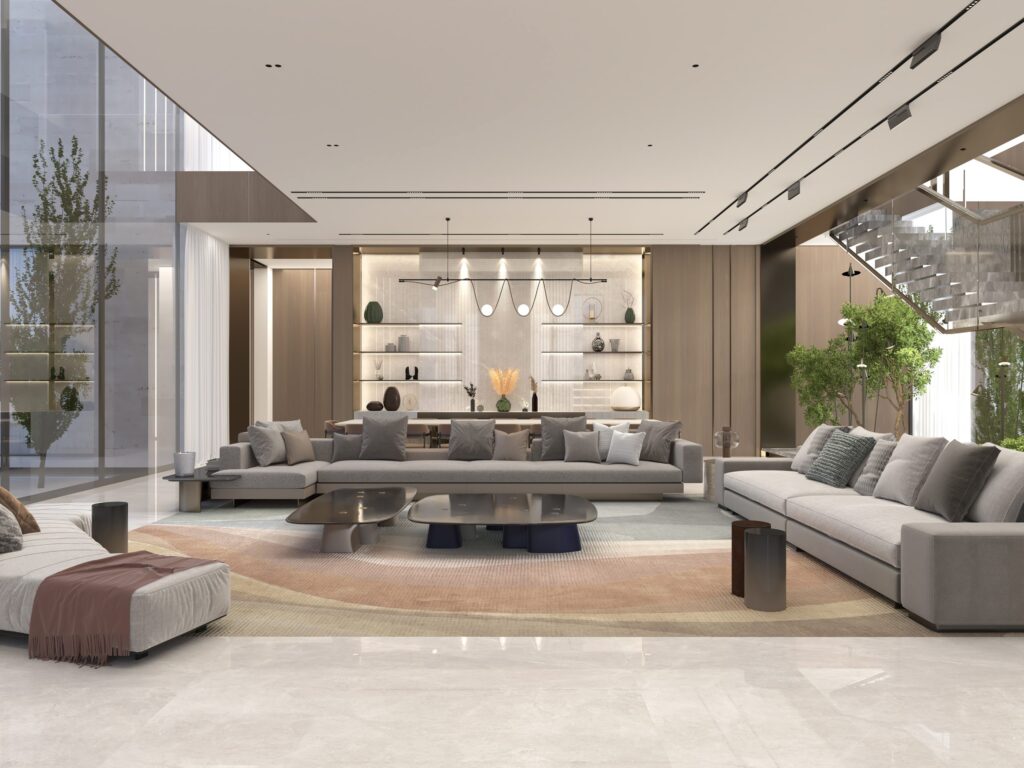
The home decoration ideas that last in a Dubai villa are the ones built into the house rather than added at the end: a single material that carries a room, walls designed to hold books and objects, light fittings treated as sculpture, planting and water brought inside, and rooms allowed their own character. Decoration chosen this way does not need replacing when the season’s look changes.
This guide gathers seven ideas we return to in the houses we design, each shown in a real IAIA project in the UAE. It is written for homeowners finishing a new villa or refreshing an existing one who want rooms that feel complete, not styled for a photograph.
How to approach home decoration in a Dubai villa
Decoration is often treated as the last layer — cushions, vases, a rug chosen after the walls are painted. In a large Dubai house that approach usually leaves rooms feeling unfinished, because the scale is generous, the light is strong and the walls are long. The answer is to decide the decorative layer early, alongside the plan and the materials, so that every object has a place prepared for it.
The seven ideas below follow that principle.
1. Let one material carry the room
The simplest way to give a room presence is to let a single material do most of the work. Fewer objects are needed when the surfaces themselves have depth.
Villa K, a 770 m² private residence in Millennium Estates, Meydan, Dubai, started from one question: what can be done with marble? Slabs were matched and wrapped across floors and walls, laid in chevrons at the entrance and fluted in the reception. Upstairs, each bedroom and bathroom takes its own stone — grey, black-and-gold or honey onyx — against walnut. The stone is the decoration. Villa K won Best Luxury Villa Interior Design in Dubai, UAE at the Luxury Lifestyle Awards 2024 and the SBID International Design Awards 2023 (Residential House Under £1M).

We explain how we select and detail stone and timber in materials in luxury interior design in Dubai.
2. Design walls to display books and objects
Collections look best when the architecture has made room for them. A shelving wall planned with the joinery — depth, spacing, concealed lighting — holds books, ceramics and family pieces without clutter.
In Villa K’s reception, a fireplace wall of travertine and walnut shelving gives the double-height room its focus. At The Canvas, a 1,200 m² residence in Sharjah completed in 2024, the family and media room is organised around long sofas and shelving, so the room is decorated by what the family actually uses.
3. Treat light fittings as sculpture
In a room with high ceilings, a light fitting can be the main decorative piece. Chosen at the concept stage, its scale can be matched to the volume, and the ceiling prepared to carry it.
In the reception of Villa K, a cloud of glass pendants hangs in the double-height space above the fireplace wall. By day it reads as an object; at night it becomes the room’s light. Layered, indirect lighting does the rest — see the use of lighting in luxury interior design.
4. Bring planting and water into the plan
Indoor plants in pots are welcome, but in Dubai the stronger move is to plan planted courts and water that every room can see. Greenery then decorates several rooms at once, and shade makes it usable.
The Canvas is a long, low travertine house pierced by water and planted patios. Full-height glass opens the rooms onto these courtyards, so the view is part of the interior. At Villa K, a pool court with a stone wall, olive trees and a timber pergola extends the living rooms outside, by day and by night.

Orientation and shade decide whether planting thrives; we cover that in designing a villa for Dubai’s light and heat.
5. Make art part of the architecture
Art does not have to mean a frame on every wall. A house can be planned around a few pieces, with walls, niches and light prepared for them — or the architecture itself can be shaped as the artwork.
The Canvas begins from a line the studio wrote for it: “Space is the canvas, art is the architecture.” Its materials are handled like natural formations, moving from grey basalt and beige travertine in the shared rooms to oak in the private ones, with a darker veined stone giving the dining hall its weight. In a house like this, a small number of chosen objects is enough.
6. Choose soft materials for comfort, not effect
Upholstery, rugs and curtains are where a room becomes comfortable. In the UAE they also have to cope with strong sun near large glazing, so durable natural fabrics in measured colours age better than delicate or saturated ones.
In Villa K’s TV room, walnut slats and soft upholstery warm a house otherwise defined by stone. The contrast — hard, cool surfaces with soft, warm furnishings — is what makes the stone rooms comfortable to live in.
7. Give each room its own character
A large villa decorated in one uniform scheme can feel like a hotel. The alternative is a shared palette with room-by-room variation: a calmer master suite, a richer dining hall, a playful children’s room.
At The Canvas the bedrooms are calm, with one playful room for the children, while the master suite pairs oak and soft light with a bathroom in walnut and stone. In Villa K, every bathroom is a different study in stone. For more on this direction, see home interior design trends in Dubai.
What to avoid when decorating a Dubai home
Buying statement pieces before the plan is fixed; high-gloss finishes that show every mark in strong light; fabrics that fade beside large windows; filling long walls with many small objects instead of a few at the right scale; and copying a look designed for a different climate and way of living.
From decoration ideas to a finished home
IAIA has designed interiors from Dubai since 1994 — more than 320 projects in 12 countries, 210 of them residential. Our interior design service in Dubai and the UAE covers the decorative layer as part of the whole project, from concept to furniture, lighting and art placement, and our furniture and design procurement team sources the pieces. The guide to villa interior design in Dubai explains the process step by step.
Home decoration ideas for Dubai villas: FAQ
When should decoration be planned in a new villa?
At the concept stage, with the plan and materials. That is when shelving walls, niches, ceiling points for feature lights and planted courts can be built in, rather than added later.
How do I make a large room feel finished without clutter?
Let one material carry the surfaces, add one or two objects at the scale of the room — a feature light, a shelving wall, a large artwork — and keep the rest calm.
Which fabrics work best in a Dubai home?
Durable natural fabrics in measured colours, with curtains or screens protecting pieces near large glazing. Saturated colours and delicate weaves fade fastest in strong sun.
Are indoor plants enough to bring nature inside?
They help, but planted courtyards and water visible from several rooms do more, provided shade and orientation are planned so the planting thrives.
Can decoration ideas be applied to an existing villa?
Yes. Shelving, lighting, soft furnishings and art can transform rooms in a renovation; built-in moves such as new stone surfaces or courtyards need more planning and are best discussed with an interior architect.
Planning or refreshing a home in Dubai or the UAE? Contact the studio to arrange a conversation.