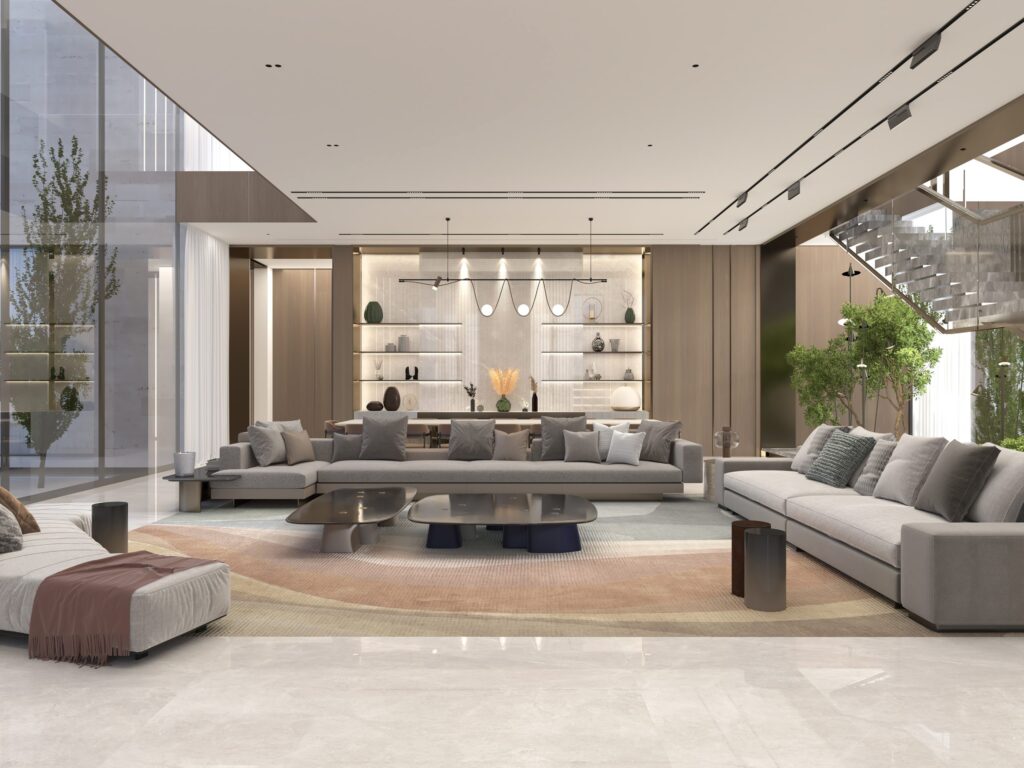
Lighting in luxury interior design starts with daylight and ends with mood. In a Dubai home, the first job is to control strong sun so it becomes something you enjoy, not something you hide from. The second is to layer artificial light (architectural light built into the structure, decorative pieces you look at, and accent light on stone, art and joinery) so every room can be bright for living and quiet in the evening. Done well, you notice the room, not the fittings.
IDEA ART Interior Architects (IAIA) has designed interiors from Dubai since 1994, on more than 320 projects in 12 countries. Below is how we plan light, with the houses and venues where each decision was made.
Why lighting matters more in a luxury interior in Dubai
Dubai gives a designer two extremes. By day, the sun is strong, low in winter and high in summer, and it falls hard on long glass facades. By night, rooms of stone and timber can look flat and cold if they rely on a grid of ceiling downlights. A luxury interior has to work at both ends of the day.
That is why we treat light as part of the architecture, not a list of fittings chosen at the end. Where light comes from, what it falls on and how it changes through the day are decided at concept stage, with the plan and the material palette. Stone, plaster and timber only look as good as the light on them.
Daylight first: screens that turn sun into shadow (The Shadow Box)
The Shadow Box is a 400 m² penthouse at Bvlgari Residences, Dubai, completed in 2021 and led by Ramzi Jizi and Darine Jabeili. Its long facade takes the sun all year. Rather than close it with heavy curtains, the design slides brass-finished panels along the glass, cut with a pattern of overlapping leaves. Daylight passes through them and moves across the rooms as shadow, so the sun becomes a pattern rather than glare.
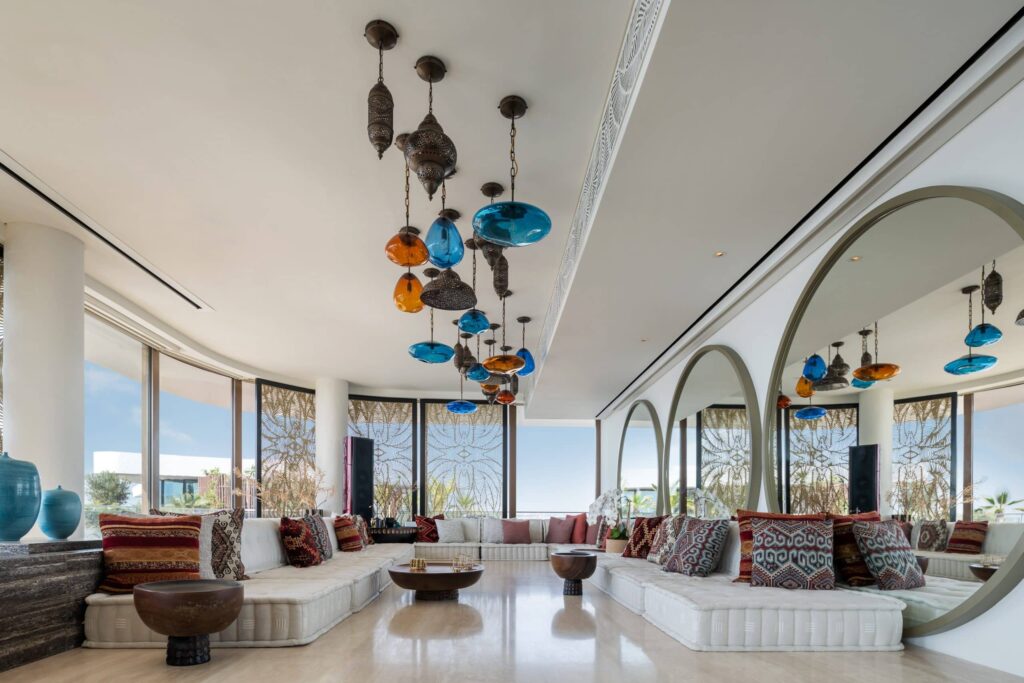
Inside, the same thinking continues after dark. Coloured pendants hang low over a travertine platform in the reception, red-lit niches line a dark gallery on the way to a crimson master bedroom, and a deep blue bedroom is lit with woven light. Each room has its own light, and the light carries the character of the room.
The penthouse won Interior Design / House & Residential at the DNA Paris Design Awards 2022 and Residential Apartment over £1M at the SBID International Design Awards 2021.
Decorative lighting at the scale of the room (Villa K)
Decorative light works best when it answers the architecture. At Villa K, a 770 m² private residence in Millennium Estates, Meydan, completed in 2023 and led by Darine Jabeili, double-height volumes mark the entrance, the stair lobby and the main reception. In the reception, a cloud of glass pendants hangs above a fireplace wall of travertine and walnut shelving. It fills the height of the room without blocking the view across it, and catches the grey marble around it.
Upstairs the approach is calmer: each bedroom and bathroom has its own marble and its own mood, set against walnut and calm daylight. Outside, the pool court with its stone wall, olive trees and timber pergola is designed to be used by day and by night.
Villa K won Best Luxury Villa Interior Design in Dubai, UAE at the Luxury Lifestyle Awards 2024 and was an ArchDaily 2024 Building of the Year finalist. For how its stone was chosen and detailed, see materials in luxury interior design in Dubai.

Hospitality lighting that sets the scene (La Casa del Tango)
In a restaurant or bar, light is part of the programme. La Casa del Tango at Gate Avenue, DIFC, a 550 m² bar, restaurant and tango school completed in 2021, was designed around the Argentinian street bar, where people dance while others watch.
The bar is the centre of the room, and it is lit from within: its shelving curves up into a vault of brass-lined cells, with tango posters set behind glass. Overhead, a deep teal coffered ceiling holds mirrored discs that catch the movement below. In the dining room, brass chandeliers and street lanterns set a warm, low light against teal walls and oxblood leather. Facing the mall, a dark panelled front with lanterns and screens draws passers-by in.
The project won Interior Design / Hospitality at the DNA Paris Design Awards 2022. More on designing hotels, restaurants and bars: hospitality interior design in Dubai.

Skylights and courtyards: bringing light to the middle of a house (Silent House)
Large villas often have rooms far from any window. At Silent House, a 1,200 m² private residence in Dubai led by Darine Jabeili and now under construction, the house is assembled around a planted courtyard at its centre. The studio’s line for it is “The Silent House speaks” — through colour, form, texture and light. Skylights bring daylight into the living room, which looks onto gardens on three sides, and the master bath sits beside a planted window.
The lesson is simple: the best light in a deep plan is often daylight from above or from a courtyard, planned with the architecture rather than added later.
How we plan lighting in a luxury interior, step by step
- Daylight study. We look at orientation, glazing and shade first: where the sun falls, when, and what it will fade or overheat.
- Layers. Each room gets architectural light (coves, concealed lines, downlights where needed), decorative light (pendants, chandeliers, lamps) and accent light (on stone, art, joinery and niches).
- Scenes. Rooms are planned for how they are used across the day: bright for working and cooking, low and warm for evenings, with dimming and simple controls.
- Coordination. Light positions are drawn on the ceiling, joinery and stone layouts, so a fitting never lands on a vein, a joint or a beam.
- Site checks. Mock-ups and installed work are reviewed on site through our project supervision.
Decorative fittings are part of the furniture list; when the design team also handles furniture and design procurement, the pieces that arrive are the ones that were drawn. The whole process is part of our interior design service in Dubai and the UAE. For how orientation, screens and courtyards shape a new villa, see designing a villa for Dubai’s light and heat.
Lighting in luxury interior design: FAQ
When should lighting be designed in a project?
At concept stage, with the plan and the materials. Fittings recessed into ceilings, stone and joinery have to be drawn before those elements are built; adding them late usually means compromises.
How do you control strong daylight in a Dubai home without darkening it?
With shade that filters rather than blocks: perforated or patterned screens, deep reveals, courtyards and skylights placed away from direct sun. At The Shadow Box, sliding brass leaf panels turn sunlight into moving shadow.
Are chandeliers still part of luxury interior design?
Yes, when they suit the room’s scale and idea. A double-height reception can carry a large decorative piece, like the cloud of glass pendants at Villa K; a smaller room usually needs something quieter.
What is layered lighting?
Combining architectural, decorative and accent light in one room, each on its own circuit, so the room can change from bright and practical to calm and atmospheric.
Is lighting different for restaurants and hotels?
The principles are the same, but the light is part of the guest experience and has to work for long evenings. At La Casa del Tango, the backlit bar and lanterns set the scene for dancing and dining.
If you are planning a villa, residence or venue and would like to talk through how light will work in it, our studio is in Dubai Design District, Building 5, A204 — contact us to arrange a conversation.